This post breaks down the specific customizations that make a sunroom work year-round and what to look for when choosing a sunroom contractor in Massachusetts.
Want to talk through options for your home? Our team is happy to help. Just reach out for a consultation.
Why Massachusetts Requires a Different Approach
Massachusetts sits in USDA Hardiness Zones 5b through 7a. Winter lows can hit single digits in the western part of the state and hover in the teens along the coast. Add freeze-thaw cycles, coastal humidity, and heavy snowfall, and you’ve got conditions that expose every weakness in a poorly built sunroom.
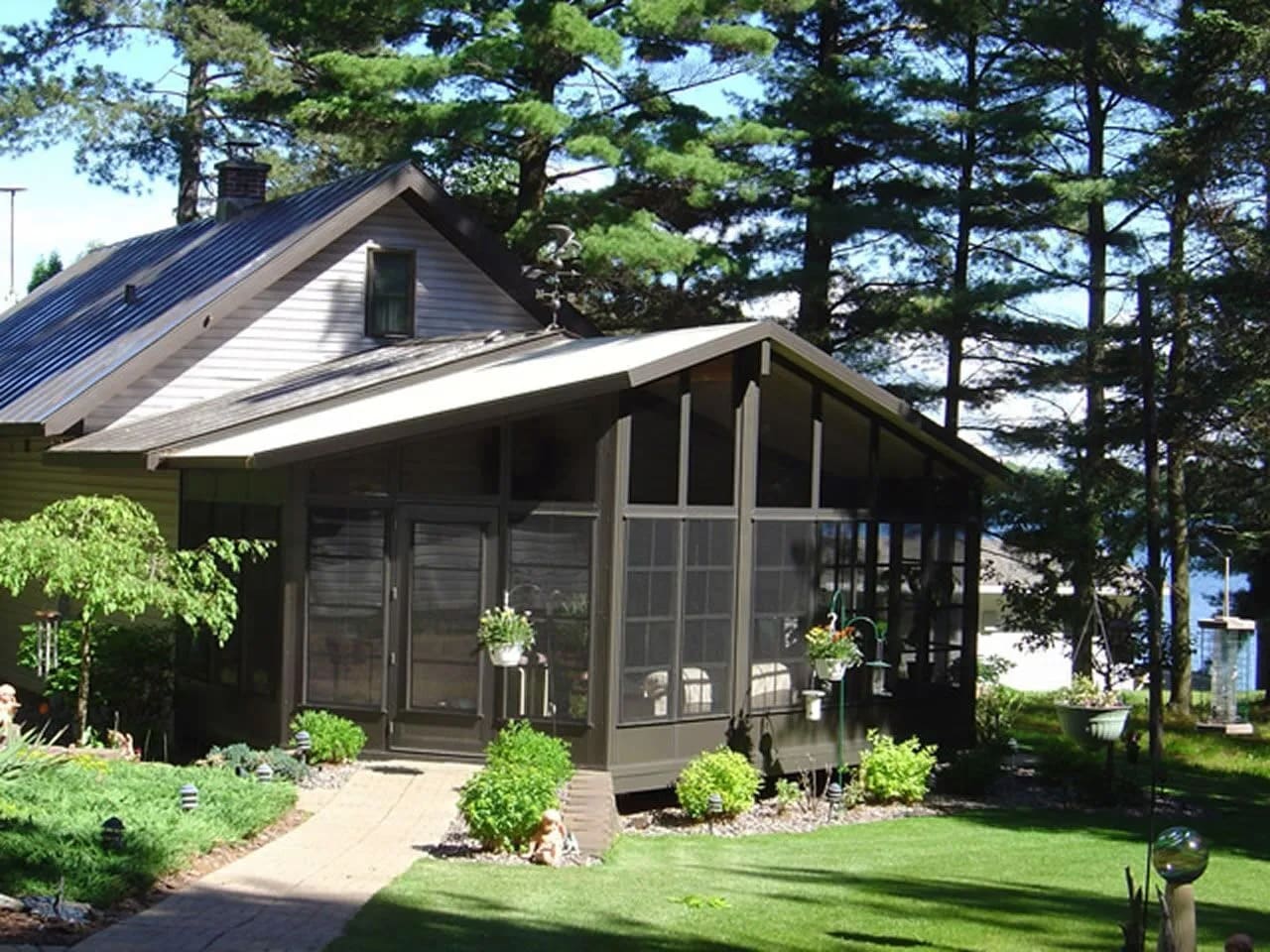
A standard three-season room isn’t designed for this. Those rooms typically use lightly insulated panels, minimal thermal framing, and no heating infrastructure. They work well from April through October. But once temperatures drop below freezing, they lose heat fast. Year-round customization means addressing each of these variables from the start.
The Core Customizations for a Year-Round Sunroom
Each feature below works together. Skimping on one tends to undercut the others.
Insulated Walls and Roof Panels
This is the foundation of any all-season sunroom. For Massachusetts climates, roof panels in the R-12 to R-24 range are standard for serious cold-weather performance. The higher the R-value, the less heat escapes through the roof. Since heat rises, the roof is where you lose the most warmth in a glass-heavy structure. A fully insulated wall assembly keeps the interior temperature stable without forcing your heating system to work overtime.
High-Performance Glass and Glazing
Not all glass is equal. For year-round use in Massachusetts, you want:
- Low-E (low-emissivity) glass: Reflects heat back into the room in winter and blocks solar heat gain in summer
- Argon gas-filled double panes: The gas between panes acts as an insulating barrier
- Tempered or laminated safety glass: Handles temperature swings and snow loads without cracking
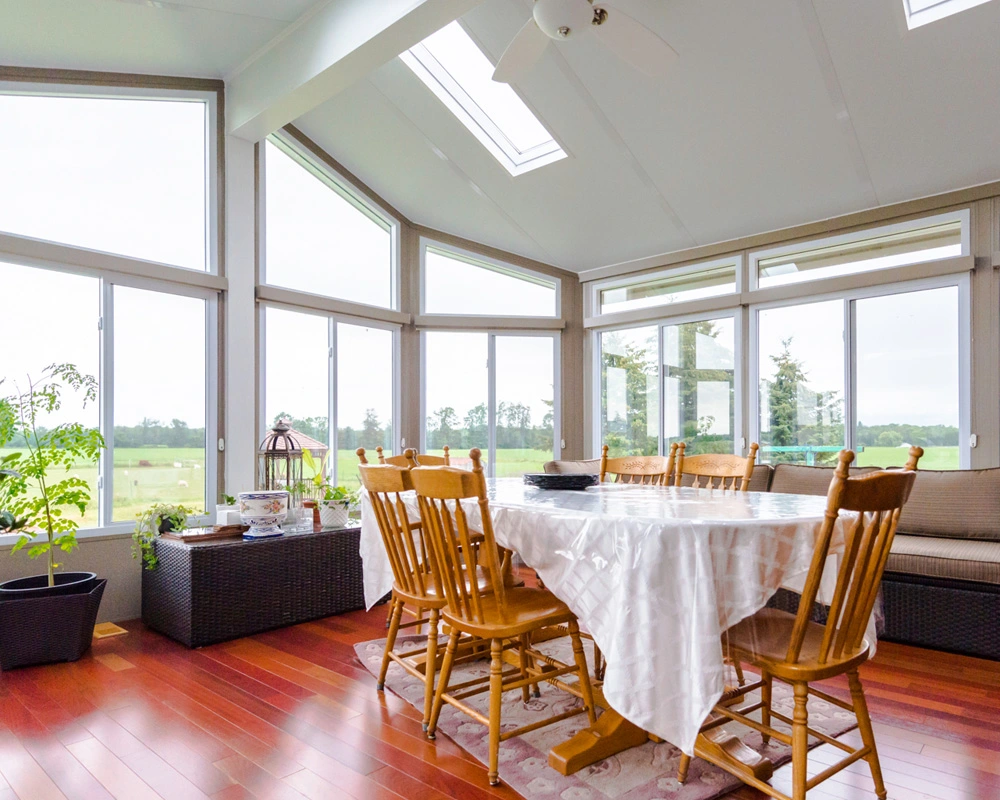
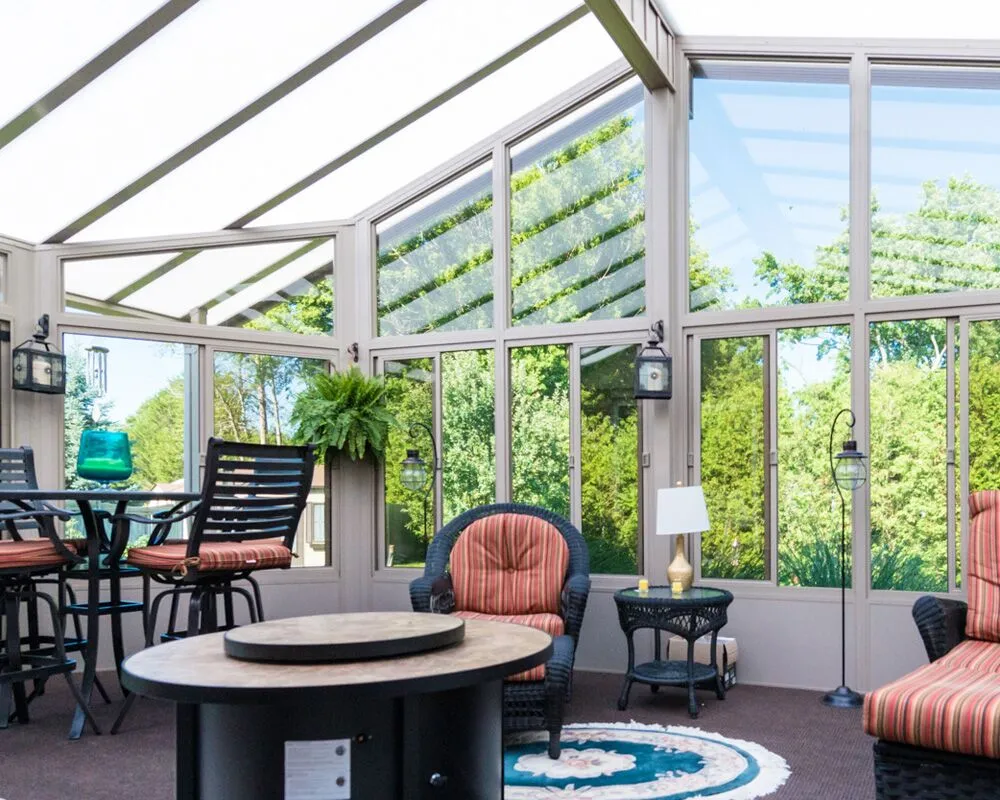
The Sunspace Model 400 All-Season Insulated Room is designed specifically with insulated walls, thermal breaks, and Low-E Argon glass for year-round New England comfort. Low-E Argon glass also reduces condensation on interior surfaces, which is a common frustration with single-pane windows in cold climates.
Thermal Breaks in the Frame
A thermal break is a non-conductive material built into the aluminum frame that stops cold from transferring from outside to inside. Without it, the metal frame itself becomes a conductor, pulling cold air into your room even if the glass and insulation are excellent. When talking to a contractor, ask specifically whether the framing system includes thermal breaks. It’s a simple question that reveals a lot about the quality of the build.
Climate Control: Heating and Cooling
A year-round sunroom needs its own dedicated temperature control. The two most practical options are:
- Ductless mini-split systems: The preferred choice for most Massachusetts sunroom additions. A mini-split handles both heating and cooling, runs efficiently, and doesn’t require tapping into existing ductwork. Most professionals recommend a separate mini-split rather than connecting to the home’s central HVAC, since sunrooms are mostly glass and the central thermostat won’t manage the space efficiently.
- Radiant floor heating: A great supplemental option for homeowners who plan to use the sunroom as a primary living space. Radiant heat is even, quiet, and comfortable underfoot on cold mornings.
Proper Foundation and Footings
Massachusetts building codes require sunroom foundations to extend below the frost line, which in most of the state is 48 inches. If the foundation isn’t deep enough, frost heave will shift and crack the structure over time. An improperly insulated slab or crawlspace also lets cold air infiltrate from below, which undermines the insulation above it. Our guide to sunroom foundation options in New England covers this in detail; the same principles apply across the region.
Additional Customization Options
Once the thermal envelope is solid, there’s room to personalize the space further:
Roof style and glass ratio: More glass means more natural light and passive solar heat gain in winter, but also more heat loss on cloudy days. A mixed roof, part glass, part insulated panel, is often the practical middle ground.
Operable windows: Sunspace WeatherMaster windows offer up to 75% ventilation when fully open and solid weather protection when closed. That flexibility matters in Massachusetts, where a 60°F day in March can arrive between two snowstorms.
Flooring: For temperature-variable environments, luxury vinyl plank, cork, or engineered hardwood performs better than standard tile. If radiant heat is in the plan, tile works well once the floor is warm.
Solar shading: Even in winter, sunrooms can overheat on sunny days. Motorized sunshades give you control over heat gain without blocking the view.
Three-Season vs. Four-Season: A Quick Comparison
| Feature | Three-Season Room | Four-Season Room |
| Wall insulation | Minimal or none | Full insulated wall assembly |
| Roof panels | Basic aluminum/vinyl | R-12 to R-24 insulated panels |
| Glass type | Single or basic double pane | Low-E Argon double pane |
| Thermal frame breaks | Rarely included | Standard requirement |
| Heating system | Portable or none | Dedicated mini-split or radiant |
| Foundation depth | Varies | Below frost line (48″ in MA) |
| Usable months | April–October | All 12 months |
Frequently Asked Questions
Do I need a permit to add a year-round sunroom in Massachusetts?
Yes. Any conditioned addition attached to your home requires a building permit. Requirements vary by town, so your contractor should handle the filing and know your local building department’s expectations.
Can I connect my sunroom to my home’s existing heating system?
You can, but it’s usually not the most efficient approach. A dedicated mini-split gives you better control and doesn’t strain your existing HVAC.
Will a year-round sunroom increase my home’s value?
Generally yes. A conditioned sunroom adds usable square footage and is counted differently from an unheated porch. The value added depends on your market and the quality of the build. For a deeper look at how sunrooms impact home resale value in New England, that’s a topic worth reviewing before you finalize your plans.
How do I know if a contractor is building a true four-season room?
Ask about the R-value of the roof panels, whether the framing includes thermal breaks, what glass specification they’re using, and how heating is handled. Clear, confident answers to those questions are a good sign.
Ready to Plan Your Year-Round Sunroom?
A four-season sunroom in Massachusetts is entirely achievable. But the features that make it work need to be built in from the beginning, not added later. Insulation, glazing, thermal framing, and dedicated climate control are all decisions made at the design stage.
If you’re ready to figure out what a year-round sunroom looks like for your specific home, the team at Sunroom Designs New England has been helping New England homeowners plan and build exactly this kind of space for over a decade. Reach out today, and we’ll walk through the details with you.